
TL;DR
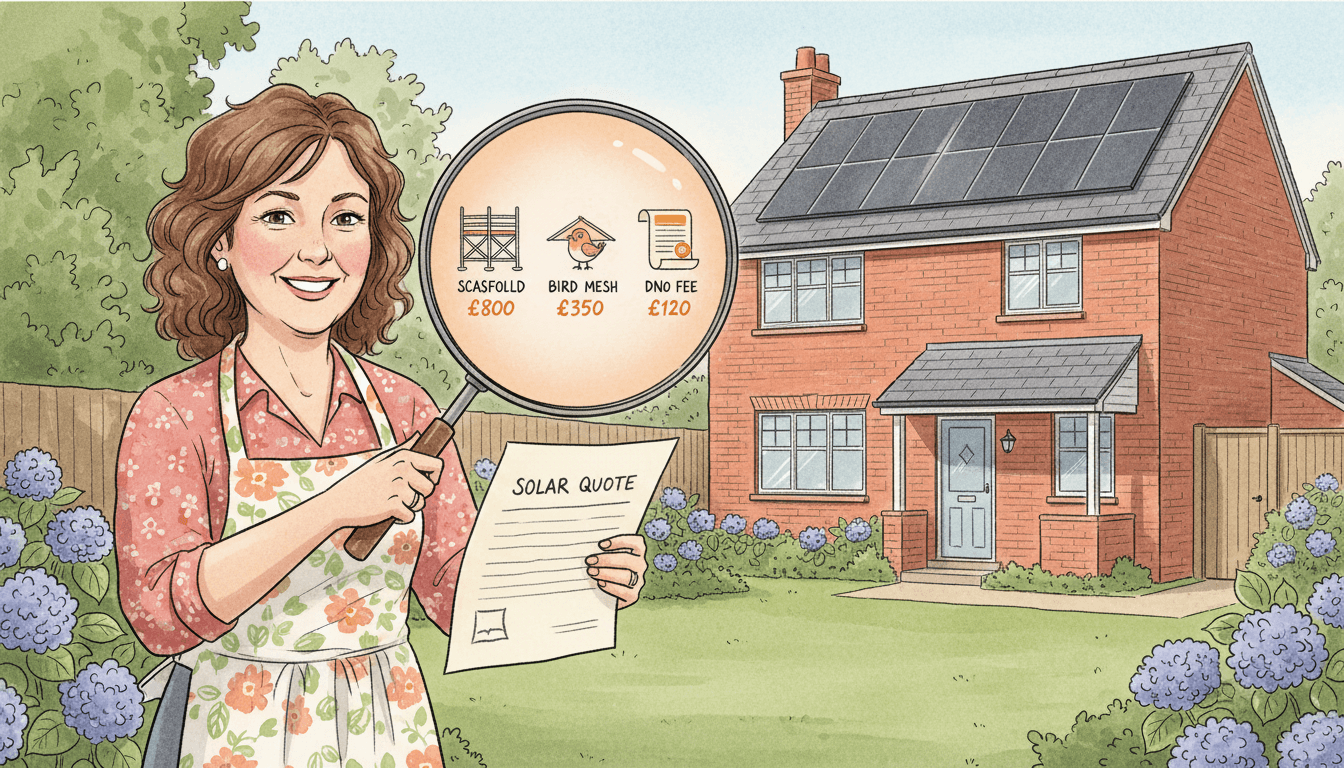
A headline quote often excludes scaffolding, DNO application fees, and bird proofing, which can add £1,000s. Grid upgrades, if needed, can cost even more. Always demand a fully itemised quote that lists every component and service before you sign.
That rock-bottom price you saw on an advert isn't always the price you'll pay. A proper solar installation has several moving parts, and some quotes are designed to hide them until you're already on the hook.
Scaffolding isn't optional
Unless you live in a bungalow and the installers are giants, your solar panel system will require scaffolding. It's a non-negotiable for safety and a legal requirement for working at height. It can easily add £800–£1,500 to the final bill.
If a quote doesn't explicitly list scaffolding, ask why. It's either been forgotten — which is sloppy — or it's a deliberate omission to make the initial price look more attractive. Both are red flags.
The DNO application
Before we can connect your panels to the grid, we have to get permission from your local Distribution Network Operator (DNO). This involves submitting a G98 or G99 application. We handle this paperwork as standard, but the process can uncover extra costs.
In rare cases, the DNO might decide your local grid needs an upgrade to handle the new generation, or that your main fuse needs changing. These costs are passed on to you and can range from a minor fee to a significant sum. A good installer will warn you about this possibility upfront.
Those 'little extras'
A few smaller items can get bundled as upsells when they should really be part of the initial conversation.
- Bird proofing. Pigeons love nesting under the warm, sheltered panels. A simple wire mesh stops them. It's much cheaper to install it at the same time as the panels than to call someone out later to deal with a family of birds.
- Optimisers. If your roof has areas of shade from a chimney or tree, you'll need optimisers or microinverters to stop one shaded panel from reducing the output of the entire system.
- AC Isolator. This is a safety switch, usually fitted near your electricity meter. It should be included as standard in any professional quote.
Quoting basic, selling premium
Some sales operations quote using low-grade, unbranded panels and inverters to produce an eye-catching price. During the sales call, they'll then push you to 'upgrade' to better equipment — like the high-efficiency AIKO N-type panels we fit — at a much higher price.
It's a classic bait-and-switch. Your quote should specify the exact make and model of the panels and inverter from the start.
The workmanship warranty
Panel manufacturer warranties vary by product and can run up to 25 years. But what about the installation itself? The brackets, the wiring, the seal on the roof? We back our work with a 2-year workmanship guarantee.
Cheaper quotes often come from firms using sub-contractors, where accountability can be murky. If a roof leak develops a year later, who do you call? Ask who will install the system, what qualifications they hold, and who is responsible if something needs fixing. Belt and braces.
Get an itemised quote
A professional quote is not a single number in an email. It's a detailed document listing every component, every service, and all associated costs. It should clearly state the make and model of panels, the inverter, the battery (if any), scaffolding, and all certification fees.
If you want a quote with no nasty surprises, designed for your specific roof and energy needs, use our solar calculator for a quick estimate or get in touch to book a proper site survey.