
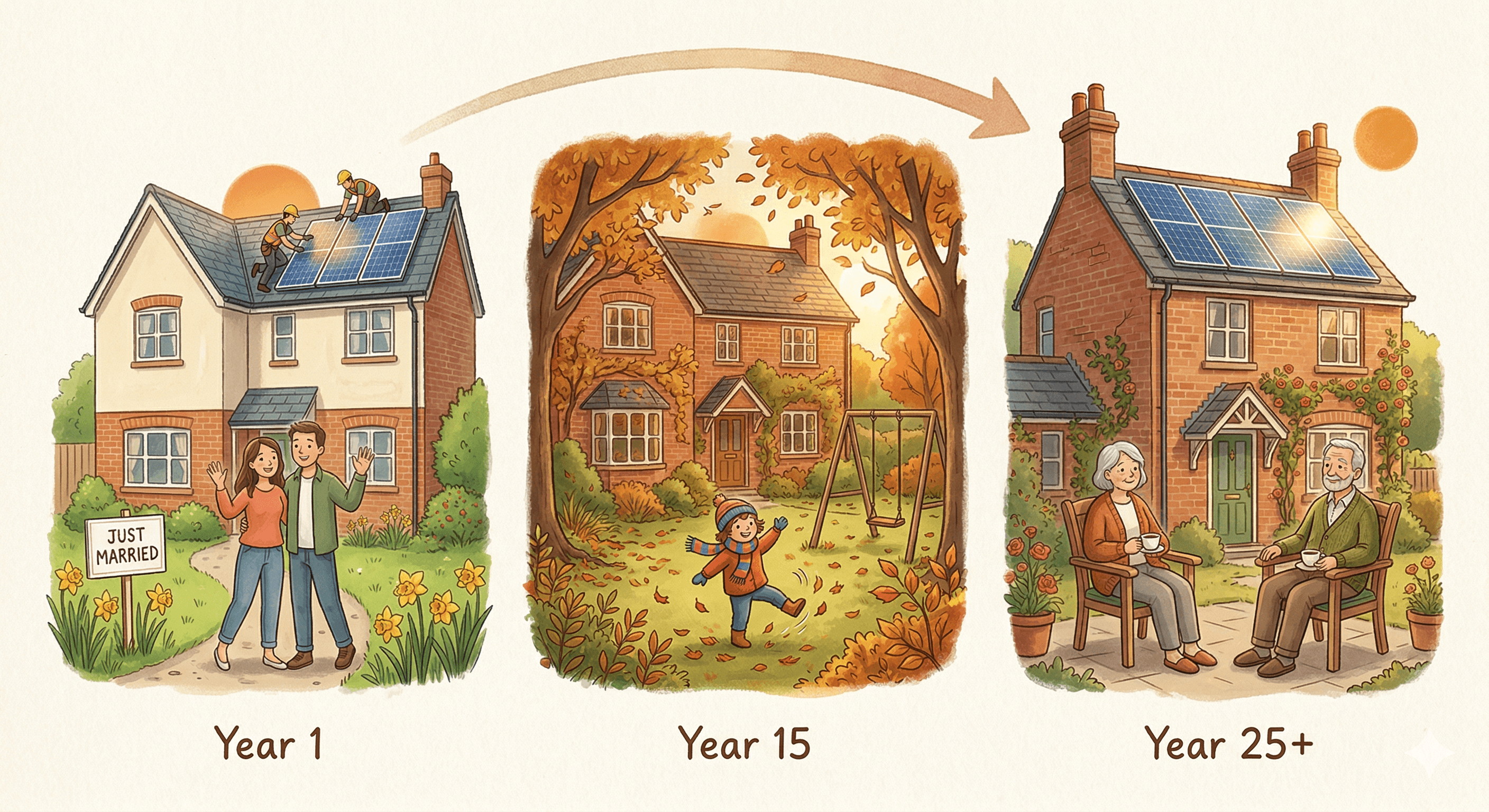
TL;DR
Solar panels last 25–30+ years with no moving parts and barely any maintenance. After 25 years they're still producing 87–90% of their original output. You'll need to swap the inverter once (£500–£1,500) and the battery after 10–15 years.
Solar panels are one of the longest-lasting things you'll ever put on your house. Seriously. They'll probably outlast your boiler, your car, and quite possibly your mortgage.
25 to 30 years — and counting
Modern panels are built to last 25 to 30 years. But they don't just stop working at that point. There's no switch that flips. They carry on generating electricity, just very slightly less each year.
The degradation rate for modern N-type panels is around 0.5% per year, according to the Energy Saving Trust. After 25 years, you're still getting roughly 87-90% of the original output. A system producing 4,000 kWh in year one? About 3,500 kWh in year 25. Still a lot of free electricity.
Why do they age so well? No moving parts. No motors, no fans, no belts. Just solid-state technology sitting on your roof, quietly doing its job.
Warranties worth having
Quality manufacturers offer a 25-year performance warranty, guaranteeing at least 80-85% output after a quarter century. Fall below that, and they replace the panels.
Here's something people miss: those warranties are often only valid if your system was installed by an MCS-certified installer. Ask installers to show the certification and warranty documents that apply before you sign.
The bits that don't last as long
Inverters last 10 to 15 years. You'll replace yours once over the panel's lifetime — budget £500 to £1,500 for a straightforward swap.
Batteries also last 10 to 15 years. They don't die suddenly; they gradually hold less charge. By the time you need a replacement, prices will almost certainly have dropped further.
What about maintenance?
Almost nothing. No oil changes, no filters, no annual servicing. We've written a full guide on solar panel maintenance if you want the details. British rain keeps the panels reasonably clean, and a professional wash every few years handles the rest.
The only thing worth doing is keeping an eye on your monitoring app. If output drops noticeably, it could indicate a fault — but that's uncommon. Most systems just tick along quietly for decades.
One thing that really matters
Installation quality. Poorly mounted panels can develop issues — water ingress, loose connections, roof damage. Choosing the right installer pays off for 25+ years. It's the single best thing you can do to protect your investment.
A 25-year lifespan is the foundation of the payback maths — read our full guide to whether solar panels are worth it in the UK for the ROI picture.